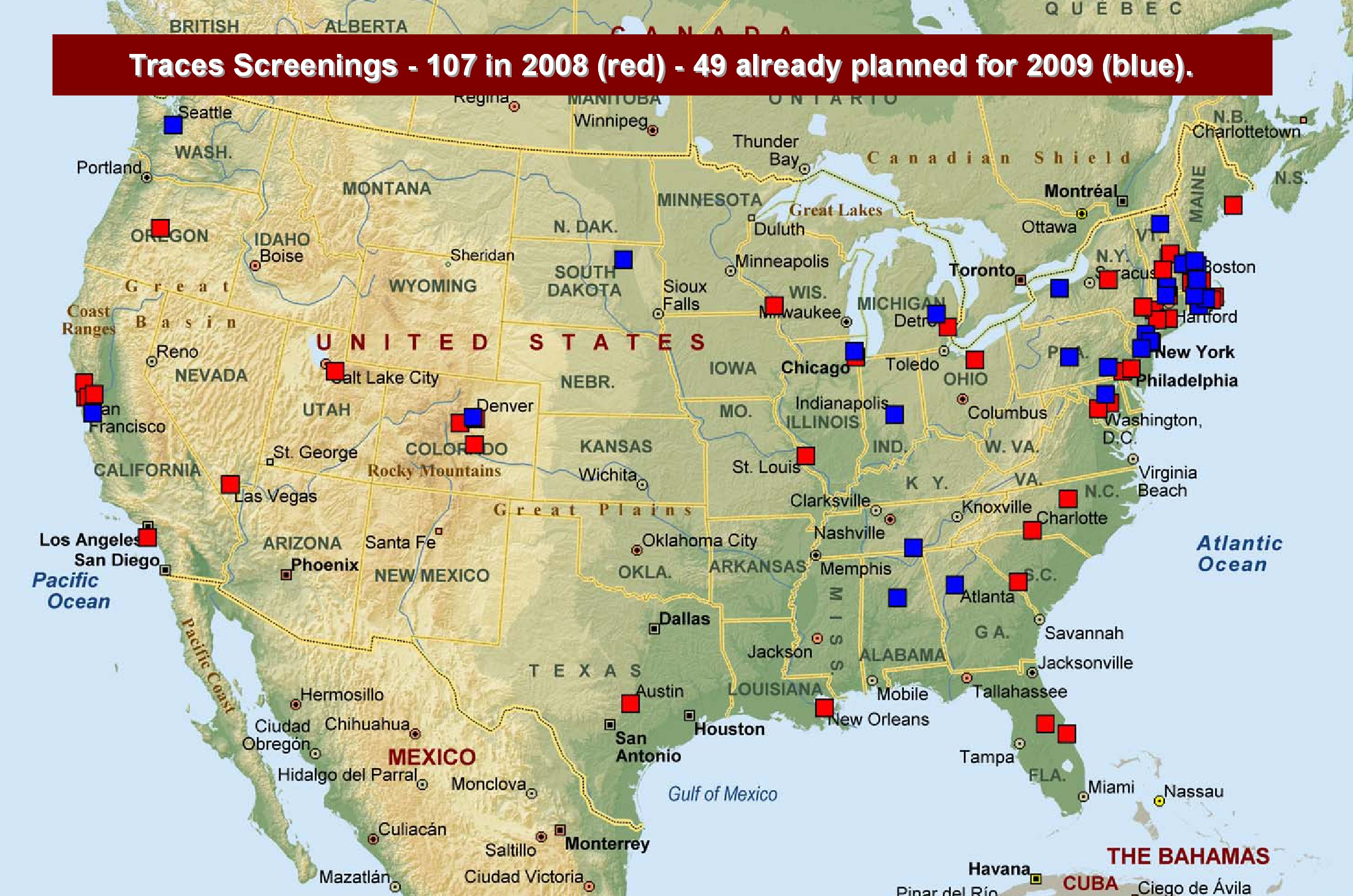






We have created a map of the United States, showing where we have offered screenings of the film, and where we are currently scheduled to screen the film.
There was also a conflict of interest in the U.S Navy Africa Ssquadron patroling the African Coast in anti-slavery activities. The Commanders had families in R.I engaged in ” the business “. One of the Commanders was Matthew Perry of Newport. I did not see or hear any reference to this in the film. Let me hear from you regarding this. Thanks in advance.
You’re quite right about this potential conflict of interest regarding the African Squadron, Mr. Pires. There is, in fact, a direct connection between James D’Wolf and the Perry family of Newport, which there wasn’t time to address in the film.
For those who aren’t aware, Matthew Calbraith Perry was the famous U.S. Navy officer who commanded the U.S. “black fleet” that “opened Japan to the West” in 1853-54.
Earlier in his career, Perry served twice with the U.S. Africa Squadron. As a young lieutenant, he helped to escort the first group of former slaves to Africa for the American Colonization Society in 1819, and was then assigned to the newly formed Africa Squadron, commanding the U.S.S. Shark in 1821. Later, when the U.S. re-established its Africa Squadron in 1843, Perry was assigned to command the squadron.
The most obvious conflict of interest was that the Perry and D’Wolf families were connected by marriage. Perry’s brother, Raymond Henry Jones Perry, married the daughter of James D’Wolf, the patriarch of the clan. It is from this union, in fact, that three of the D’Wolf family members in the film–Jim, Dain, and James Perry–descend.
I had initially assumed that this conflict of interest would have meant that Perry had little interest in chasing down illegal slave traders off the coast of Africa.
In fact, however, the D’Wolf family was out of “the business” by this time, and Perry seems to have taken his job quite seriously.
He is reported to have fallen in love with Africa during his first voyage, when he became involved in local affairs, personally selecting the site of Liberia’s future capital, Monrovia. Perry requested his two assignments with the Africa Squadron, and these were not career-enhancing moves. The U.S. squadron was notoriously small and under-funded, and there was little political impetus in the U.S. to enforce the ban on the slave trade.
It turns out that Perry’s instructions from the secretary of the navy in 1843, for instance, precluded him from effectively pursuing slave traders. He did press the secretary for additional resources specifically to catch slave traders, but was denied. He seems to have spent most of his time protecting the colonies of former American slaves which had sprung up along the west African coast.
I am now curious about Matthew Perry’s Civil War service, which appears to come between this command in the U.S. Africa Squadron in the 1840s and his famous voyage in the Pacific to sail the “Black Ships” to Japan. Any information or sources for research?
Actually, Michael, Commodore Perry’s visit to Japan occurred in 1853-54, so it was prior to the U.S. Civil War. He died later that decade, and so did not serve during the Civil War.
March 6th, 2009 at 10:44 am
There was also a conflict of interest in the U.S Navy Africa Ssquadron patroling the African Coast in anti-slavery activities. The Commanders had families in R.I engaged in ” the business “. One of the Commanders was Matthew Perry of Newport. I did not see or hear any reference to this in the film. Let me hear from you regarding this. Thanks in advance.
March 6th, 2009 at 12:48 pm
You’re quite right about this potential conflict of interest regarding the African Squadron, Mr. Pires. There is, in fact, a direct connection between James D’Wolf and the Perry family of Newport, which there wasn’t time to address in the film.
For those who aren’t aware, Matthew Calbraith Perry was the famous U.S. Navy officer who commanded the U.S. “black fleet” that “opened Japan to the West” in 1853-54.
Earlier in his career, Perry served twice with the U.S. Africa Squadron. As a young lieutenant, he helped to escort the first group of former slaves to Africa for the American Colonization Society in 1819, and was then assigned to the newly formed Africa Squadron, commanding the U.S.S. Shark in 1821. Later, when the U.S. re-established its Africa Squadron in 1843, Perry was assigned to command the squadron.
The most obvious conflict of interest was that the Perry and D’Wolf families were connected by marriage. Perry’s brother, Raymond Henry Jones Perry, married the daughter of James D’Wolf, the patriarch of the clan. It is from this union, in fact, that three of the D’Wolf family members in the film–Jim, Dain, and James Perry–descend.
I had initially assumed that this conflict of interest would have meant that Perry had little interest in chasing down illegal slave traders off the coast of Africa.
In fact, however, the D’Wolf family was out of “the business” by this time, and Perry seems to have taken his job quite seriously.
He is reported to have fallen in love with Africa during his first voyage, when he became involved in local affairs, personally selecting the site of Liberia’s future capital, Monrovia. Perry requested his two assignments with the Africa Squadron, and these were not career-enhancing moves. The U.S. squadron was notoriously small and under-funded, and there was little political impetus in the U.S. to enforce the ban on the slave trade.
It turns out that Perry’s instructions from the secretary of the navy in 1843, for instance, precluded him from effectively pursuing slave traders. He did press the secretary for additional resources specifically to catch slave traders, but was denied. He seems to have spent most of his time protecting the colonies of former American slaves which had sprung up along the west African coast.
March 30th, 2009 at 11:32 am
I am now curious about Matthew Perry’s Civil War service, which appears to come between this command in the U.S. Africa Squadron in the 1840s and his famous voyage in the Pacific to sail the “Black Ships” to Japan. Any information or sources for research?
March 31st, 2009 at 5:46 am
Actually, Michael, Commodore Perry’s visit to Japan occurred in 1853-54, so it was prior to the U.S. Civil War. He died later that decade, and so did not serve during the Civil War.